Innovation is not only a driver of profit but also a matter of survival for businesses
Ho Chi Minh City, August 21, 2025 – Amid globalization and the rise of artificial intelligence (AI), Vietnamese businesses stand at a historic crossroads: either breakthrough through innovation or be left behind. This message resonated strongly at InnoEx 2025, the international forum and exhibition on innovation and sustainable development, which brought together more than 4,000 business leaders, investors, and experts from over 60 countries, attracting 30,000 participants.
More than just a showcase of technology, InnoEx 2025 posed a critical question: Does innovation truly generate profit, and how can it become the lifeline for Vietnamese enterprises in the era of data and AI?
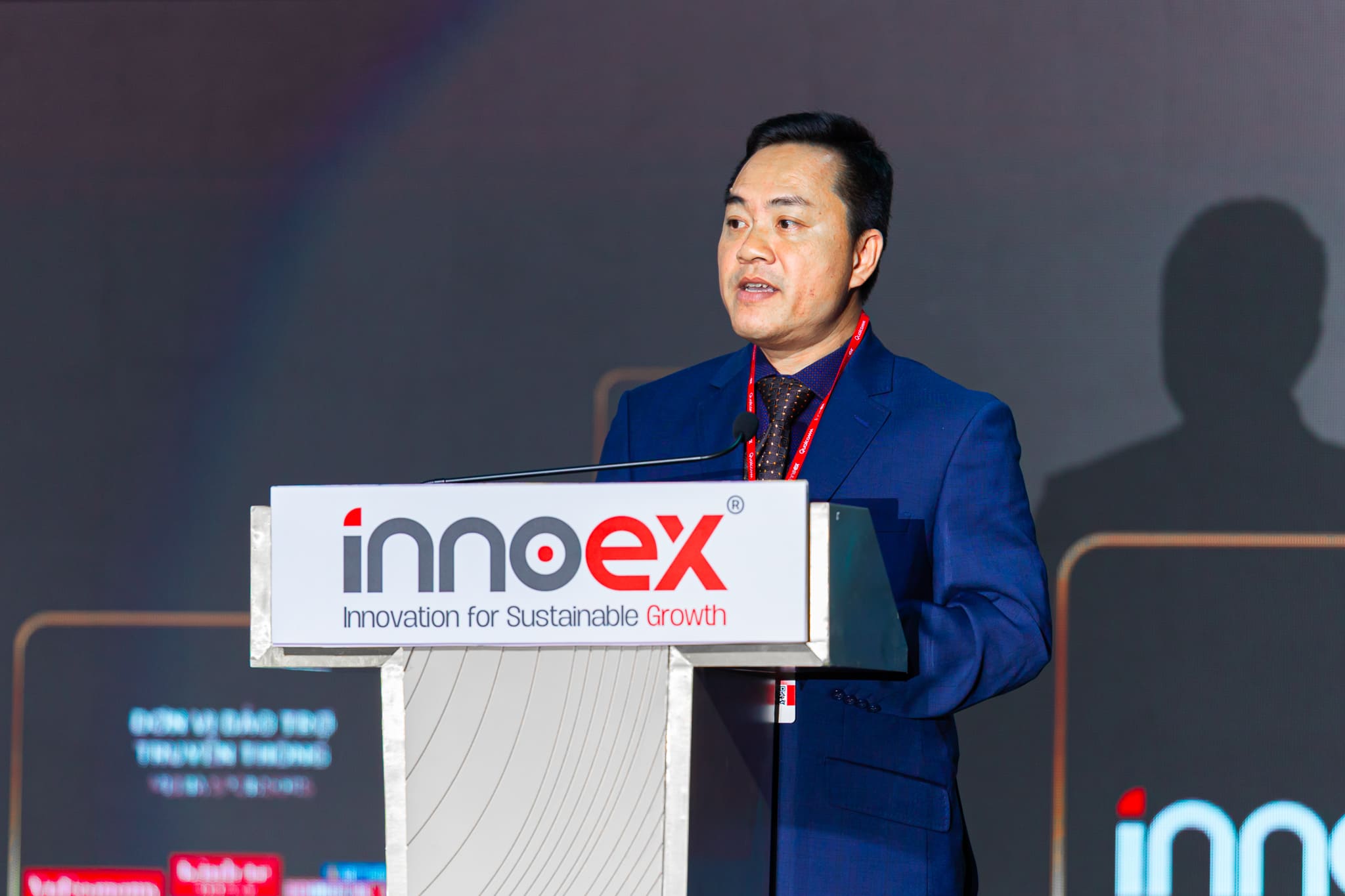
Mr. Pham Huynh Quang Hieu, Deputy Director of the HCMC Department of Science and Technology, speaks at the InnoEx Business Innovation Forum
Innovation – From Slogan to Survival Instinct
The business world offers stark reminders of the cost of lagging behind in innovation. Kodak, inventor of the digital camera, was undone by the very technology it created. Blockbuster, once a video rental giant, collapsed within years of Netflix’s rise. Research by Innosight (2023) shows the average lifespan of S&P 500 companies has fallen from 61 years in 1958 to just 18 today, and is expected to drop below 15 by 2030.
Vietnam faces a similar challenge. Once-prominent domestic brands are struggling to keep pace with rapid technological change and shifting consumer behavior. A McKinsey report (2024) found that companies integrating AI at scale could raise efficiency by up to 40% and cut costs by around 30% within three years. In retail, Bizplanr (2024) noted that 87% of global retailers already use AI in at least one business area, with more than 80% of executives expecting to complete operational automation by the end of 2025.
Such figures are no longer projections—they mark the dividing line between survival and decline.
InnoEx Business Innovation Forum 2025
InnoEx Action Map: Innovation for Profit
At the Business Innovation Forum, leaders from both technology firms and traditional industries revisited a critical question: innovation should not only ensure survival, but also deliver tangible profits.
From a global perspective, Mr. Sudeepto Roy of Qualcomm highlighted the power of Edge AI in real-time data processing, enabling businesses to leverage immediacy as a new source of competitive advantage.
“There are more than 30 billion edge devices worldwide — from smartphones and cars to smart glasses and industrial IoT systems. This edge network is bringing artificial intelligence closer to everyday life,” he noted.
Mr. Sudeepto Roy, Vice President of Engineering Qualcomm
He emphasized that AI is no longer confined to massive data centers; with mobile technology, compact and personalized models can now be deployed directly on devices—both energy-efficient and user-centric.
“The edge AI ecosystem is opening opportunities across all sectors — from agriculture, healthcare, and smart industry to smart cities, robotics, and drones. Qualcomm is working with more than 70 startups worldwide, including several projects in Vietnam. This shows that edge AI is no longer the future; it is the present — and it is the business and startup community here today who will shape it,” he noted.
In a related keynote on “Turning Data into a Growth Engine,” Mr. IL-Dong Kwon of BCG Vietnam underscored that “Data is the key to success. Companies with superior data capabilities not only grow revenue 1.7 times faster but also generate 4.2 times higher total shareholder returns compared to late adopters. This advantage comes from harnessing data at scale through advanced applications — from predictive modeling and analytics to powerful commercialization levers.”
Mr. IL-dong Kwon, Head of BCG Vietnam
In practice, leaders such as Le Tri Thong (PNJ), Nguyen Hong Viet (SAP Vietnam), and Truong Ly Hoang Phi (IBP) demonstrated a “dual front”: safeguarding traditional industries while leveraging technology for expansion. Here, AI is not a luxury but a competitive weapon that can determine a company’s survival.
Decoding AI’s advantages in logistics, Mr. Luong Duy Hoai (GHN) surprised the audience when he revealed:
“What once took months to process can now be done in minutes. GHN can analyze one billion orders with 100 data fields each and generate a strategic report in just 30 minutes. Transparent, rapid, and accurate data processing enhances operational efficiency and creates a significant gap with competitors.”
GHN has also optimized its operations through the advances of Edge AI, echoing Qualcomm Vice President Sudeepto Roy’s earlier remarks. The company has digitized every touchpoint in the delivery journey, transforming them into data points. For instance, requiring couriers to use smartphones allows GHN to collect data at minimal cost, while Edge AI enables real-time processing directly on each device.
At the same time, Mr. Hoai stressed that applying AI across industries requires deep technological understanding to make the right, optimal choices.
Panel discussion featuring Mr. Luong Duy Hoài (GHN) and Mr. Nguyen Hong Viet (SAP Vietnam), moderated by Mr. Le Tri Thong (PNJ)
Summarizing the panel discussion for traditional enterprises, Le Tri Thong emphasized: “From a business perspective, we always seek to turn assets into profits. Yet short-term profits can sometimes become the very barrier that prevents us from achieving long-term gains. Many early movers failed to adapt their business models or to build data as a strategic asset—and as a result, they missed the chance for true breakthroughs.”
His message to today’s leaders was clear: profit comes in different forms. Short-term profit requires fast-moving operational assets, while long-term profit demands investment in strategic assets such as data and innovation. Only by overcoming the pressure of short-term gains can we create sustainable, strategic profit.
Ms. Truong Ly Hoang Phi and Mr. Le Hong Minh in the Executive Dialogue
Decoding what makes an investment truly worthwhile in a conversation with Truong Ly Hoang Phi, Chair of the InnoEx Organizing Committee, Le Hong Minh, Founder & Chairman of VNG, remarked candidly: “Innovation often requires investments that may not yield immediate profits but can create long-term competitive advantages. We once made mistakes by investing out of a ‘fear of missing out’ (FOMO). The lesson is to invest in areas you truly understand—start small, but execute fast. In the technology race, if you move too slowly, you will be left behind.”
Citing VNG’s approach to AI investment, he explained: “When collaborating with Nvidia, we did not choose to invest heavily from the outset. Our strategy was to experiment at low cost and move quickly, building capabilities and preparing for larger steps once the market became clearer.”
From a leadership perspective, Mr. Minh underscored the critical role of the CEO in sustaining innovation capacity: “Innovation always starts with leadership. If leaders lack the aspiration to change, companies cannot go far. Only when leaders dare to try and dare to change can businesses create real breakthroughs.”
Over two days (August 21–22, 2025), the event not only featured the InnoEx Forum – Innovation for Profit, but also ran in parallel with the Green Innovation Summit, Startup Wheel, Capital Connect, and numerous investment and trade networking activities. With more than 300 exhibitors and dozens of in-depth content sessions, InnoEx reaffirmed its role as a platform for action—connecting businesses, governments, investors, and startups on the journey of innovation.